


Tunable White LED Spot | 60° Ra90 2200-6500K 24V 4W+4W
Item Code: 81061M04 / Series: Expert
Tax included, Free Shipping (8-15days)
Tips:
Highlights
8W 24V Tunable White LED Spot for DALI DT6 (Dual-Address), DT8 and KNX Control
For KNX, DALI and Loxone lighting projects that need a wide-range 2200–6500K tunable white 24V LED spot — and a direct alternative to the ConstaLED 31346 — the TILLUME 81061M04 Expert delivers 4W+4W dual-channel output with over-temperature protection and a compact MR16 form factor.
This spot works best with controllers that can drive warm white and cool white as two separate channels, such as MDT KNX LED actuators in max brightness mode (both channels are on at the same time during CCT changes, so up to ~8W is possible in the mid CCT range) or suitable dual-channel DALI DT6 (two separate DALI addresses, one per white channel) / 24V PWM controllers. With DALI DT8 (tunable white control via a single DALI address) or MDT constant output brightness (both channels are active but switch on and off in a set ratio within each PWM cycle, keeping total output around 4W), the spot can still be used, but the max wattage is 4W.
For reliable 24V operation, the 81061M04 Expert spot also includes over-temperature protection and an inrush-current suppression circuit for switch-on events.
The compact MR16/GU10-like form factor fits many suitable frames and housings, but check installation tolerance, thermal space and strain relief before using it in larger projects.
Technical data
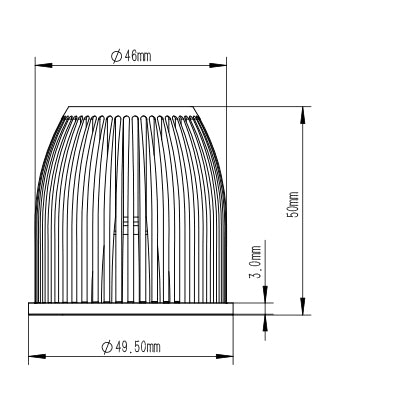
Technical documentation opens in a new tab.
In summary: the 81061M04 Expert spot has a rated power of 8W (when both warm white and cool white channels are driven at full output), a rated current of 0.33A at 24V DC, and a combined luminous flux of approximately 710 lm.
📄81061M04 Expert datasheet
Electrical, optical, mechanical and wiring details for this 4W+4W 2200–6500K tunable white spot. For more detailed parameters and measured performance data, please check the full test report.
✓Best for
- Indoor general lighting projects that need wide 2200–6500K tunable white control
- Projects using MDT AKD-0424R in max brightness mode, dual-channel DALI DT6 (two separate DALI addresses), KNX two-channel PWM or suitable 24V PWM controllers
- Projects looking for a direct alternative or replacement option for the ConstaLED 31346 24V MR16 tunable white spot
!Check first
- If the project uses DALI DT8, MDT constant output brightness or another power-balancing tunable-white controller, plan this spot as max. 4W total output.
- If the project needs higher brightness with DT8 or constant-output control, consider the Expert 8+8W 2200–6500K version.
- If very low tint deviation is more important than the widest CCT range, compare the narrower 2400–4000K tunable white version.
- If the lighting space has high R9 requirements, choose the Master 24V LED spot series.
Still comparing 2200–6500K, 2400–4000K or Dim-to-Warm? Read our tunable white LED spot guide before choosing the final version.
Read the guide↓Quick navigation
Want to learn more before ordering? Choose the topic you care about most and jump directly to the matching section below.
1Choose matching parts for your 24V tunable white setup
Build the setup around four basics: a suitable frame or housing, dual-channel tunable white control, a 24V power supply and clean wiring accessories.
01 · Mechanical fit

FRMR16 frame or spot housing
Choose a recessed frame or surface-mounted housing that fits the MR16/GU10-like module size, installation depth and thermal space.
02 · CCT control

CTDALI / KNX / 24V PWM controller
The controller should provide suitable outputs for warm white and cool white, enough channel capacity and the right dimming logic for DT6, DT8 or constant-output operation.
View DALI and KNX LED controllers →03 · 24V power

PS24V DC power supply
Plan the total circuit load, keep around 20% reserve, and check compatibility with the selected controller and installation location.
04 · Wiring

CBConnectors and cable accessories
Good wiring depends on the real cable route, wire cross-section, current, voltage drop and available connection space.
View compact splicing connectors →2Compare related 24V tunable white spot options
If this 2200–6500K Expert spot is not the perfect match, these related options help you choose for tighter white-point control or higher CRI/R9 requirements.
Sensitive to pink or magenta tint?
Compare the narrower 2400–4000K tunable white version for projects that prioritise neutral white mixing in the common residential CCT range.
View 2400–4000K tunable white optionsNeed highest CRI/R9?
View Master 24V LED spots when CRI >95, high R9 and light quality are the main project priorities.
View Master CRI>95 LED spots3Plan spot quantity and check 24V voltage drop
Not sure how many spots you need or whether the cable run is suitable? These tools help with spot quantity and 24V voltage-drop checks.
🖩Estimate how many spots you need
The 24V LED Spot Planner helps with early room planning: target lux, beam angle, layout spacing, approximate spot quantity and 24V power load.
VCheck voltage drop before installation
The Voltage Drop Calculator helps you compare cable length, wire cross-section, current, power loss and power-supply position for the final 24V circuit.
4Planning checks before ordering
Before ordering, make sure the selected controller, power supply, cable route and housing work together in the real installation.
Optics and light quality
- 2200–6500K tunable white, 60° beam angle, Ra >90 on the individual channels and up to Ra >95 with mixed control around 4000K.
- Best suited for general lighting. For spaces with higher colour-rendering or R9 requirements, choose the TILLUME Master series.
- With DALI DT8 or other power-balancing tunable-white controllers, the maximum output is 4W. If higher brightness is needed, choose another TILLUME 24V tunable white spot, such as the Expert 8+8W version.
Electrical planning
- Plan up to 8W only when both warm white and cool white channels can be driven independently at full output, such as dual-channel DALI DT6 (two separate DALI addresses), KNX two-channel PWM or MDT max brightness output mode.
- For DALI DT8, MDT constant output brightness or other power-balancing modes, use 4W as the maximum total output for this spot.
- Size controller channels from the real output logic, keep around 20% PSU reserve and check voltage drop along the actual cable route.
PWM and dimming
- Dimming is handled by the upstream 24V PWM output; recommended PWM frequency for most projects is 1–4 kHz.
- Under suitable control conditions, this spot can support around 0.1% at 1 kHz PWM and around 1% at 4 kHz PWM.
- The real minimum brightness often depends more on the LED actuator or controller settings than on the LED spot itself.
Mechanical and wiring
50 mm length, 49 mm diameter and 150 mm connection cable. When using the 84021D04 mounting frame, plan about 65–70 mm of ceiling installation space so heat dissipation, cable routing and strain relief are not too tight. Check the dimension drawing on the 84021D04 product page before larger installations.
Need more help with your 24V lighting project? Email us at tillume@tillumelight.com.
5Which systems can this 24V tunable white LED spot be used with?
The 81061M04 Expert spot is designed for 24V constant-voltage lighting circuits. The higher-level system may be KNX, DALI, Loxone or another system using a suitable 24V PWM LED controller. What matters is the final output to the LED spot: it must match the power, channel count, PWM quality and required dimming curve.

KNX
Suitable with KNX LED controllers or KNX LED dimming actuators that provide matching 24V outputs for warm white and cool white.

DALI
Suitable with standard DALI DT8 tunable white controllers for power-balanced tunable white control, or with two DALI DT6 channels (two separate DALI addresses, one per white channel) when warm white and cool white should be planned separately.

Loxone
Suitable for Loxone lighting systems when the selected 24V output provides two controllable channels for warm white and cool white and the load per channel stays within the controller limit.
24V PWM controller
Also suitable with common WiFi, Zigbee and Bluetooth wireless 24V PWM LED controllers when two channels for warm white and cool white are available and the channel load, PWM frequency and dimming curve match the spot.
6How different controllers affect 4+4W output planning
Different controllers can make the same 4+4W spot behave differently. The notes below help you choose the right setup and plan the real usable output.
How MDT AKD-0424R ETS settings affect 4+4W output
Key takeaway
Use max brightness when the project needs more available output around the mid CCT range — both warm white and cool white channels are on at the same time. Use constant output brightness when the room should stay more evenly bright — both channels are active but switch on and off in a set ratio within each PWM cycle, keeping total output stable.
The 4+4W tunable white spot is a good fit for the MDT AKD-0424R when the ETS setup and output planning match the selected brightness behaviour.

Example: MDT KNX LED actuator for 24V outputs
MDT AKD-0424R KNX LED actuator
The MDT actuator provides the 24V output on the KNX side. In ETS, the designer defines whether the room should have more output in the mid CCT range or a more even brightness impression when changing colour temperature.
Max brightness mode · planning with 4+4W output
In max brightness mode, both warm white and cool white channels are on at the same time during CCT changes. In the mid CCT range, the 4+4W spot can therefore reach up to around 8W total output.
Constant output brightness · standard planning
In constant output brightness mode, both channels are active but switch on and off in a set ratio within each PWM cycle instead of being on at the same time. This keeps total output around 4W while the colour temperature changes.
Once the MDT ETS output behaviour is chosen, planning for this 4+4W spot becomes clearer. Max brightness mode (both channels on simultaneously) suits projects that need more available output in the mid CCT range. Constant output brightness (channels switch in a set ratio per PWM cycle) suits rooms that should remain more evenly bright when colour temperature changes. In both cases, check warm white and cool white output, around 20% PSU reserve, channel load and voltage drop.
How max power output works with a 4+4W tunable white spot
In max-power-output mode, the MDT AKD-0424R can use the warm white and cool white channels more strongly at the same time in the mid CCT range. This allows a 4W+4W tunable white spot to reach up to around 8W total output there. At the end points, one channel dominates: warm white at low CCT and cool white at high CCT.
Simplified illustration: the actual curve depends on ETS parameters, controller logic and project target.
Key point: The higher total output is not a fixed value across the whole CCT range. It requires suitable ETS configuration, enough channel reserve, a suitable 24V power supply and controlled voltage drop.
How DALI DT8 and DT6 affect brightness and max wattage
With standard DALI DT8 tunable white control, colour temperature and brightness are handled through a shared power-balancing logic. This is practical for smooth CCT control, but each channel does not behave like two independently driven full-power DT6 or PWM channels. In this control logic, the max wattage is 4W for this spot.
| Controller type | Examples | Planning note |
|---|---|---|
| DALI power supply / controller DT8 | 89453849-CWW-24V | For tunable white logic with shared control. |
| DALI LED dimmer CV, DT8 | 89453836, 86458673, 89453838, 89453841, 89453841-HS | Check output power and behaviour in tunable white operation. |
| DALI 2-channel LED dimmer CV, DT6 | 89453827, 89453833, 86459561, 89453830, 89453840-HS | Useful when two channels should be planned separately. |
When is 8W total output possible?
The 4W+4W rating describes the two LED channels: warm white and cool white. Whether both channels can be driven at full power at the same time depends on the controller. For full 8W operation, the project needs independent channel control, enough output power, suitable parameters and a 24V power supply with sufficient reserve.
If a controller uses constant total output or a shared brightness curve in tunable white operation, the real total output may be lower. This is not a fault of the spot; it is part of the controller logic.
7Planning FAQs
Is this a replacement option for ConstaLED 31346?
Yes. It is a direct replacement option for the ConstaLED 31346 24V MR16 tunable white spot in comparable 4W+4W projects, with a compact MR16/GU10-like form factor and 2200–6500K CCT range.
Which version should I choose for the most neutral white point?
Choose this 2200–6500K version when the project needs a very wide tunable white range. If very low tint deviation in the common residential CCT range is the priority, consider the TILLUME 2400–4000K tunable white version and review the spectrum report.
What is the brightness difference between DALI DT8 and DT6 for this spot?
With DALI DT8 or other power-balancing tunable-white control, plan this spot as max. 4W total output. Up to 8W planning is only relevant when warm white and cool white can be driven independently at full output, such as with two DALI DT6 channels (two separate DALI addresses), KNX two-channel PWM or MDT max brightness output mode.
Can this spot be dimmed very low without flicker?
The spot can support very low dimming levels under suitable PWM control, around 0.1% at 1 kHz and around 1% at 4 kHz. In practice, flicker and minimum brightness are often decided by the LED actuator, PWM frequency, dimming curve and minimum-level parameters, so test the final controller setup.
Is CRI enough for all rooms?
This Expert 2200–6500K spot is a strong fit for general lighting where flexible CCT is the priority. For galleries, colour-critical kitchens, retail displays or spaces with high R9 expectations, choose the TILLUME Master series or review detailed test data before ordering.
Last updated: July 2026
Since 2015
DTW development
Built around real KNX and DALI controller requirements.
Custom COB
Not off-the-shelf
Chip selection, phosphor and binning are specified for stable light quality.
Reflector optics
Cleaner mixed beam
Designed to reduce visible CCT separation in DTW applications.
System reliability
Driver + heat path
Electrical and thermal margins matter more than headline lifetime claims.
01 / Development
Development of Tunable White 24V LED Spots
TILLUME has been developing dim-to-warm LED lighting products since 2015. At that time, KNX and DALI tunable white controllers were still limited, and many controller platforms were originally built around single-CCT or DT6-style applications. Our early product development therefore focused on compatibility with the most common control methods available in real projects.
The challenge
Available dual-CCT COB options were limited. Some early market solutions offered only CRI 80, restricted customization and insufficient brightness for our target applications.
Our solution
We worked with partners to develop a two-CCT COB and designed a dedicated circuit for constant-voltage PWM signal input with a 3-wire connection.
Optical requirement
Because the light-emitting position changes during CCT adjustment, the optical system must mix light carefully to avoid visible colour separation.
02 / Construction
Key Components in a 24V LED Spot Module
A high-quality LED module is not the result of one single component. It depends on chip selection, COB packaging, driver design, optical design and heat dissipation working together as a system.
LED chips
The LED chip is the core of the COB. Chip quality affects brightness, colour accuracy, heat generation and service life. TILLUME places enough large-size chips within the limited COB area so each chip has more operating margin at the required current.
Larger chips can improve light efficiency and reduce heat stress, helping to limit colour shift and improve long-term stability.
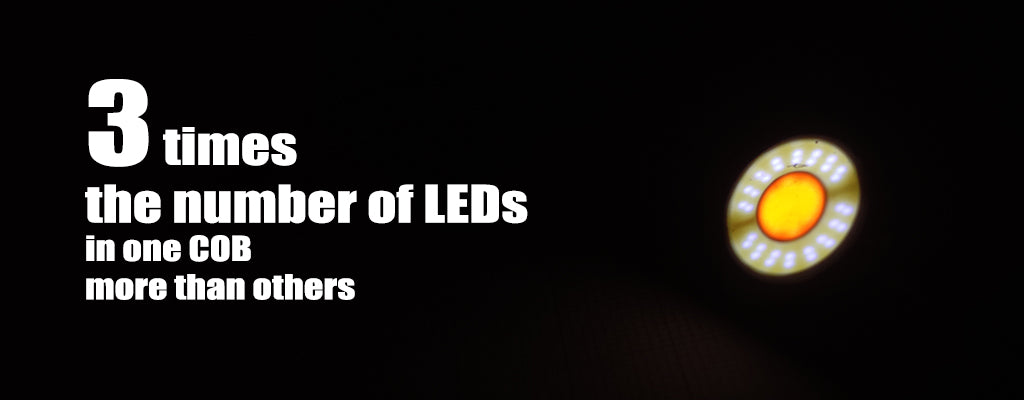
COB packaging process
Instead of simply purchasing a common COB from the market, TILLUME cooperates directly with LED chip and LED packaging partners. The LED chips are fixed on a high-reflectivity aluminium substrate, connected with gold wire and covered with phosphor.
Every COB is tested for photoelectric performance to improve consistency in light colour and electrical behaviour. For higher reflective efficiency, we use high-reflectivity material from German manufacturer Alanod as part of the COB substrate solution.
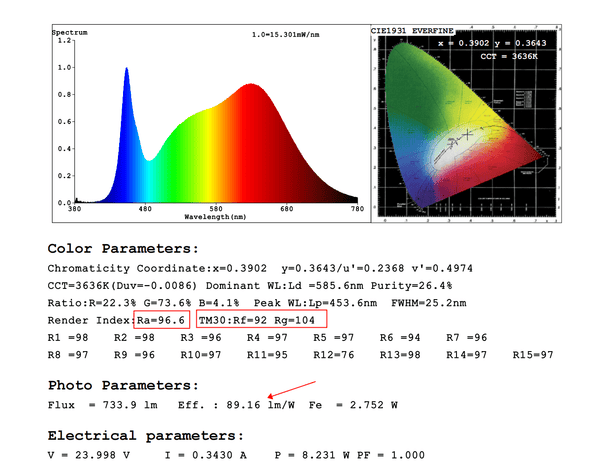
High colour rendering is not only about a CRI number. We also care about the relationship to the Planckian locus and colour-quality behaviour that users can actually see in warm residential lighting.
03 / Electronics
Specialized Circuit Driver for 24V PWM Systems
Low-voltage installations may experience voltage drop along the cable. In simple LED products, changes in input voltage can cause changes in LED current, which may create visible brightness differences between modules installed at different distances.
TILLUME uses a dedicated constant-current optimized circuit inside the spot module. Within the intended voltage range and system conditions, this helps the module keep a more stable drive current and reduces visible brightness inconsistency.

04 / Thermal Design
Heat Dissipation: Why Real Lifetime Depends on Temperature
LED lifetime claims are often based on idealized test conditions. In real luminaires, the COB, bonding materials and internal driver circuit all operate at elevated temperatures. Better thermal design is therefore one of the most important factors for long-term reliability.
6063 aluminium
Selected for better thermal conductivity compared with lower-cost aluminium options often used in LED housings.
Larger heat path
The module body and fin structure are designed to increase contact area with surrounding air.
Driver heat transfer
Internal PCB and mechanical design help conduct heat away from electronic components.


Test condition shown above: 24V input, both channels at maximum power, operated until the temperature stabilized after approximately 20 minutes.
05 / Optical System
Lens or Reflector?
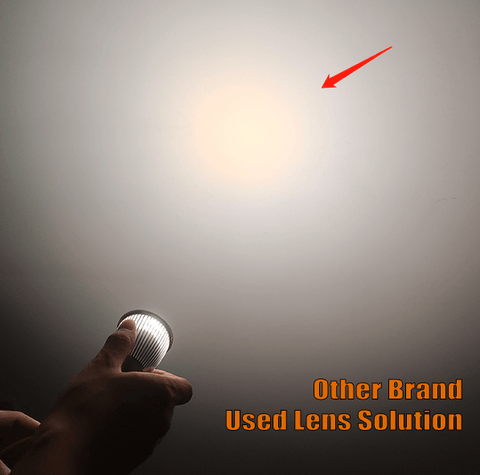
For dual-CCT COBs, a lens can easily amplify colour separation because the emitting position changes during CCT adjustment. A reflector-based system gives us more control over light mixing before the beam leaves the module.
Common lens risk
The centre and edge of the beam may show different colour temperatures, especially during dim-to-warm transitions.
TILLUME reflector approach
A mixing part and reflector system help blend different CCT directions before forming the final beam.


The metal reflector also avoids the yellowing risk associated with some plastic optical parts after long-term operation.
06 / Quality Control
Strict Quality Control Process
Incoming material control
Important materials are inspected with higher attention before entering production.
Colour consistency
COB and chip sorting are used to improve consistency between modules and batches.
Appearance standard
Mechanical details and surface finish are controlled to match the product positioning.
Aging test
Each lamp goes through an aging process to reduce the risk of early failure after shipment.
Built for serious 24V smart lighting projects
TILLUME DTW spots combine custom COB development, PWM-compatible electronics, reflector optics and thermal engineering for professional KNX, DALI and low-voltage lighting systems.
Explore TILLUME DTW Spots